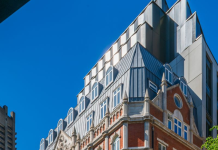











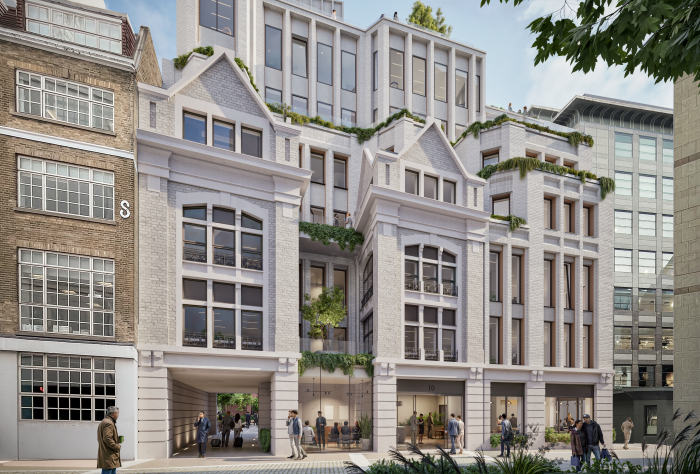
The City of London Corporation has granted planning approval for John Robertson Architects’ (JRA) transformation of St Bride’s House at 10 Salisbury Square. The redevelopment will offer 52,500 square feet of high-quality Grade-A office space, strategically located next to the City’s new Justice Quarter.
As the first project within Original Works’ portfolio, a joint venture between the developer Simten and Investor Invesco Real Estate Europe Fund III, the designs for 10 Salisbury Square showcase Original Works’ bold vision of exemplary sustainable central London office schemes, seamlessly integrating cultural sensitivity with innovation and re-use.
JRA’s design embodies an ambitious, progressive yet pragmatic sustainability strategy, demonstrating a clear commitment to heritage-sensitive and climate-responsible development solutions. The project prioritises tangible, carbon-efficient outcomes with the intention of making a positive, long-term impact to both the local community, and wider environment.
Nestled in the historic Fleet Street Conservation Area, 10 Salisbury Square stands in close proximity to several key architectural landmarks, including the Grade I listed St Bride’s Church – an iconic Wren-designed building with strong historical ties to the newspaper industry. To the north and east, the building is framed by Sir Edward Lutyens’ Grade II listed Reuter’s building, one of London’s finest examples of neoclassical architecture, and the Victorian St Bride’s Institute, home to the world’s largest collection of typefaces.
The existing building, however, is a product of a 1980s attempt to merge two Victorian gatehouse facades within a six-storey, brown-brick office development. The result was a façade that clashes with its heritage surroundings, lacking the visual coherence, material sensitivity, and presence needed to engage with its context.
After over two decades without substantial refurbishment, the building no longer meets current energy efficiency standards and requires a major upgrade to remain viable for modern office use. The proposed redevelopment provides a much-needed opportunity to resolve these architectural and environmental shortcomings, creating an exemplary workplace development with the highest sustainability credentials that meets evolving occupier needs and enhances the surrounding historic environment alongside public realm improvements for the local community.
In line with the City Corporation’s retrofit-first policies, JRA’s design will retain more than 90% of the building’s existing structural frame, focusing interventions only where necessary to improve both the building’s functionality and energy performance and enhance occupant wellbeing.
Favouring localised over wider high-carbon interventions, one of the key features of the design is a striking four-storey oriel window on the rear elevation, which opens up breathtaking views of St Bride’s Church, allowing occupants a unique connection to the City’s urban landscape. A modest two-storey extension with additional rooftop plant has been strategically placed on the eastern side of the building, minimising the impact on local views, particularly preserving the iconic view towards St Bride’s Church’s spire – famously inspiring the tiered wedding cake.
Using St Bride’s House as its own material bank, salvaged components of the existing façade are repurposed to extend the building, whilst their removal enlarges windows, improving natural light, energy efficiency and views out. This approach not only resolves the building’s inherent design flaws but also enhances its historic integrity, ensuring that interventions are within the spirit of the original design.
To create a cohesion, a whitewash treatment is applied to the entire brick façade, unifying various architectural elements and reinforcing the building’s connection to its historic Portland stone dominated context. The new, harmonised appearance creates a singular new identity and improve the setting of nearby listed buildings. and singular new identity
Sustainability, health, and wellbeing lie at the heart of the design, ensuring benefits for both building occupants and the local community. The UK NZCBS pilot project is set to meet the highest environmental standards, aiming for EPC A, BREEAM Outstanding, and NABERS 5* ratings.
The building features photovoltaic panels, providing a significant portion of its remaining energy needs following optimised fabric performance for lower energy usage, while a 55m³ water attenuation tank will capture rainwater for irrigation and toilet flushing. Occupant-controlled openable windows will provide zero-energy cooling, and the building’s intelligent passive façade design will maximise daylight, green views, and fresh air.
Landscaped roof terraces will transform the rooftop into urban gardens, enhancing both environmental sustainability and occupant wellbeing. The project will also integrate a landscaping strategy designed by PAD Landscapes, which will boost biodiversity by 2450% and integrating with the emerging Justice Quarter masterplan.
The currently unloved St Bride’s Courtyard is transformed into a tranquil pocket garden, creating a peaceful retreat amidst the bustling City. This redesigned space celebrates local heritage, improves pedestrian permeability, and contributes positively to the revitalisation of Salisbury Square and the Fleet Street Conservation Area – helping to foster a vibrant cultural hub in the heart of the Square Mile.
Anja Schellenbauer, Director at JRA, stated:
“10 Salisbury Square underscores how strategic retention, contextual sensitivity, and commercial viability can be aligned to deliver genuinely sustainable, progressive and future-proof office developments.
By focusing on targeted, high-impact interventions, and retaining the vast majority of the existing structure, the scheme significantly reduces embodied carbon while elevating environmental performance, occupier wellbeing and urban quality.
As the first project in Original Works’ portfolio, 10 Salisbury Square sets a benchmark for how climate-responsible development can both enhance historic contexts and deliver positive ESG outcomes.”