



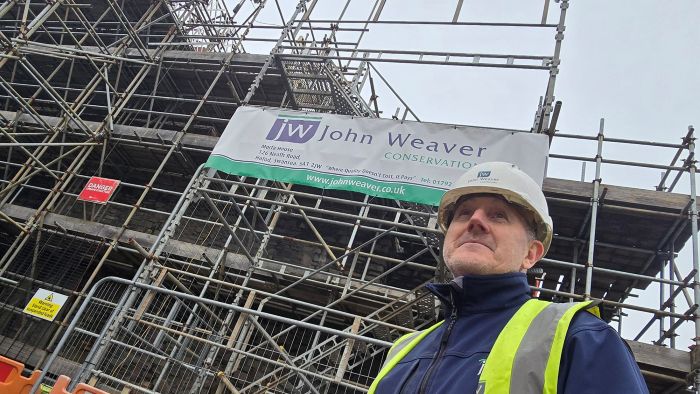
The Laboratory Building at the historic Hafod Morfa Copperworks site is being reconstructed by John Weaver Contractors in a project driven by Swansea Council.
Future uses of the structure, next to Landore’s Penderyn Whisky base, could include it becoming a restaurant for more than 100 diners. It’ll also be suitable for a range of alternative uses.
The work is part of the council’s ongoing programme to regenerate the Lower Swansea Valley. It’s being helped by funding from the UK Government’s Local Regeneration Fund.
Council leader Rob Stewart said: “We’re saving the Laboratory Building and bringing it back into use.”
Council joint deputy leader David Hopkins said: “The copperworks site is a key part of Swansea’s heritage and we see it becoming a major leisure destination.”
Council cabinet member Elliott King said: “Penderyn are there, we’ve saved two historic engine houses and we’ve installed a boating pontoon on the river. Further progress on our Lower Swansea Valley Project will be made this year and next.”
The contractors are repairing and enhancing the Laboratory Building’s fabric and fully repairing and refurbishing the exterior and key internal elements.
Initial work at the grade two listed Laboratory Building – thought to date from the second half of the 1800s – saw hundreds of red bricks and other masonry items removed from an unsafe 12m-high chimney stack.
They’re being cleaned and stored safely for their re-use in the project.
Work on site has seen the Swansea-based contractors stabilise the building, making it safe and undertaking delicate and sensitive stonework repairs.
Preparations are now well underway to make it watertight with measures including the installation of a new Welsh slate roof
Old archways are being stabilised and fitted with new and reused stone, wall cornices are being repaired by expert stonemasons, steelwork is being put in place, a large chimney breast has been rebuilt. Stone, bricks and tiles are being reused.
New external doors and windows will be fitted along with a terrace and level access making it accessible to all.
John Weaver Contractors began work on-site around 16 months ago – and the project is due to be complete this year (note: 2026). At that point it’ll be ready for an internal fit-out by the business selected to take it on. The council’s search for an end tenant for this ornate building will progress shortly.
In the copperworks’ heyday, copper ore from around the world was smelted in Swansea site, putting the area at the centre of a global web of copper trading connections.
The Laboratory Building was probably used to test the quality of copper ore coming into the copperworks that helped put Swansea on the world’s industrial map.
It’s architecturally the most ornate of all the surviving buildings on the copperworks site, with many classical features. However, it became derelict and unsafe in recent decades, losing much of its roof.
The two- and three-storey structure, with ornate windows and a fine stone doorcase, stands next to the Morfa Gates, once a key copperworks entrance.
Partners involved with its transformation include GWP Architecture and Coreus Group.
Other heritage buildings already saved for Swansea include the Palace Theatre building and the Albert Hall.
The transformations are part of the council’s £1bn regeneration of Swansea. This includes a range of other Lower Swansea Valley schemes including new pontoons on the River Tawe, the reinstallation of Morfa’s historic bascule bridge, the revamp of the Vivian and Musgrave Engine Houses and the transformation of the V&S No.1 Locomotive Shed.