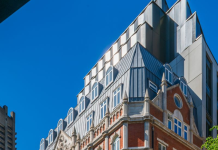











Grant Thornton UK, a leading business and financial adviser, has relocated to new London headquarters designed by HLW. The office sets the bar for reuse and sustainable design, reducing embodied carbon by 79%.
The London office of the international architecture and interiors practice was appointed to design a sustainable and inclusive workplace for Grant Thornton’s 95,000 sq ft office in 8 Finsbury Square.
HLW’s in-house sustainability consultancy, BEYOND, collaborated closely with the client to establish comprehensive sustainability guidelines. Anchored by three core themes – decarbonisation, reuse, and human-centred design – the framework integrates sustainability from inception to execution.
As a result, the scheme reduced embodied carbon by 79%, with 38% alone from repurposed flooring. The project also reused over 1,700 pieces of furniture and a barista bar, which was dismantled, transported, and reassembled at the new headquarters – a testament to effective cooperation between construction and design. By prioritising reuse, HLW avoided 1,336 tons of CO2 from the atmosphere, equating to 2265 flights from NYC to London.
Jonce Walker, Principal, MD of BEYOND said:
“The BEYOND team conducted various Life Cycle Assessments throughout the project to ensure that all design decisions were vetted through a lens of decarbonisation in alignment with the progressive goals set out by Grant Thornton.”
Items that could not be reused or repurposed were donated to a local charity, Waste to Wonder, redistributing the redundant office furniture to community organisations. Through this partnership, HLW diverted 100% of construction and demolition waste from landfill.
Where new materials were needed, HLW sourced materials that aligned with the scheme’s sustainability guidelines and had a low Global Warming Potential (GWP). This included renewable cork, coffee-ground-based furniture from sustainable manufacturer Mater and Foresso worktops which are made from a minimum of 65% waste wood content sourced from the UK.
Cohesion between new and reused materials was a priority. By seamlessly blending the modern and the refurbished in the design, HLW created a space that is easy for employees to navigate and fosters a unified atmosphere.
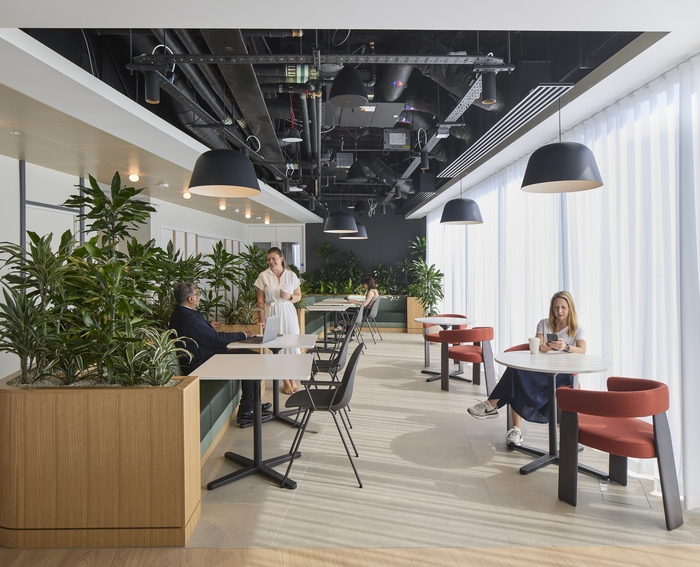
Natural, honest, and warm tones run throughout the space, contrasting with pops of Grant Thornton’s signature purple. An open and naturally lit double height space with an existing feature staircase welcomes employees into the office. Enhancing this arrival with a new planter bed surrounding the base of the staircase, a strong biophilic story is created from the arrival.
The various wellness rooms – from the reflection room and relaxation room to the wudu foot bath and multi-faith prayer rooms – promote wellbeing. With expansive views of the London skyline, the 8th floor terrace provides a generous outdoor space for employees to step away from their desks.
.
The diverse workspaces accommodate for changing user needs, offering both quiet spaces and communal areas, centred around ‘tea points’ to foster connection and collaboration.
Shelley Quinn, senior designer at HLW, said:
“This project is a prime example of a successful partnership between a designer and a client. Grant Thornton had bold sustainability ambitions, which we were able to meet through a close and collaborative design process. Importantly, alongside minimising embodied carbon, we have created an attractive, efficient and cohesive environment for staff. Thanks to the variety of workspaces and integrated wellness rooms, the office design encourages teams to connect both professionally and personally.”
Richard Jamison, Head of Property and Procurement at Grant Thornton UK, said: “This move marks a major milestone in our sustainable property strategy. By prioritising reuse and low-impact design, we’ve created a space that reflects our values and supports the wellbeing of our people. It’s a bold step forward – not just for Grant Thornton, but for the industry. The new office is a tangible expression of our commitment to responsible growth, and it sets a new benchmark for how sustainability and inclusivity can shape the future of work.”