
















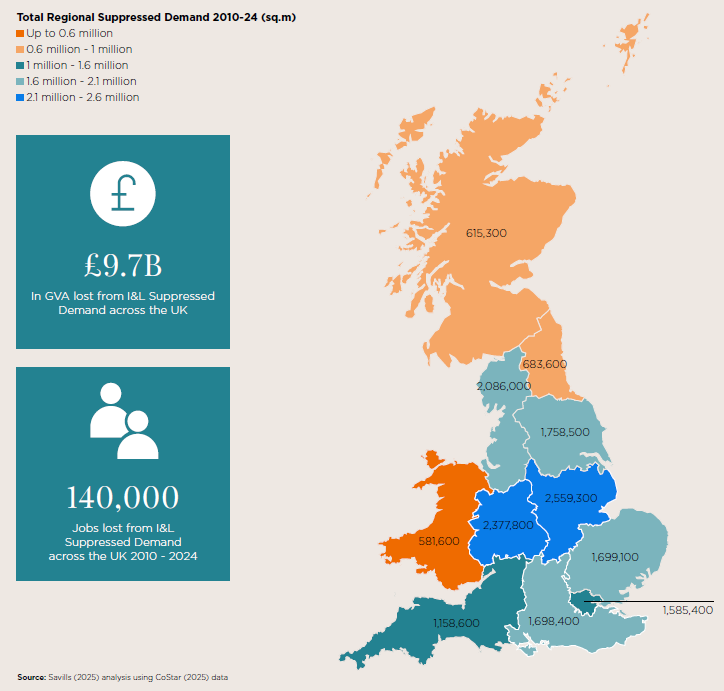
A report published by the British Property Federation (“BPF”) and Savills shows that the historic undersupply of industrial workspace across the UK has artificially suppressed demand and cost the UK more than 140,000 jobs and also £9.7bn in economic output (GVA) – roughly the same economic output as a mid-sized city – since 2010.
The report, Industrial & Logistics: The Infrastructure Of Everything, shows that the availability rate for industrial and logistics (“I&L”) space has been below 8% – the ‘healthy’ rate at which supply and demand is broadly in balance – for well over a decade (2010 – 2024), preventing businesses from accessing the workspace they need to thrive and grow.
According to the analysis, demand would have been 37% higher over the period 2010-2024, if supply had kept pace. The supply crunch has had the most pronounced impact on demand in the Midlands ‘golden triangle’, London and the South East.
According to the report, delays in the planning system and unsupportive policy are providing major obstacles to development.
Just 18% of major applications are decided within the statutory 16-week period, with 26% taking more than a year, adding to costs and uncertainty for developers.
Planning policy does not fully recognise the importance of I&L space to the economy. There is no requirement for planning authorities to set targets for employment uses as they do with housing, meaning insufficient land is allocated in the right locations. In addition, data shows 51% of demand for I&L space is uncorrelated to housing and population growth meaning accurate real-time market data is needed to forecast the demand for space from companies across a range of sectors.
Meanwhile, there is a real risk that the supply of I&L workspace could be further diminished by incoming sustainability regulations. The report finds that 73% of existing I&L floorspace falls below EPC ‘B’, which is set to become the mandatory Minimum Energy Efficiency standard from 2030. If swathes of I&L space become unlettable the impact on employment and economic output would be significant across the country.
The infrastructure of everything – increased investment into AI and defence among structural drivers that will increase demand for I&L space
The report highlights that modern industrial and logistics space is highly adaptable and critical for a wide range of sectors. Industrial and logistics activity is also fundamental to the Government’s eight priority growth sectors, accounting for around 22% of their inputs, equivalent to approximately £250bn each year.
According to the analysis, between 2019-2024 more than half (57%) of floorspace has been leased to businesses outside of logistics and manufacturing which historically have driven take-up.
Over this period, 26% was leased to retailers reflecting the continued growth of e-commerce, with total online spend set to reach £99bn by 2029. Meanwhile, a fifth (20%) was leased to science, R&D and professional services. In addition, 7% of total floorspace was let to information companies, primarily data centre operators, with the boom in AI and growth of the digital economy set to fuel further demand.
There is currently 2.4m sqm of industrial space occupied by defence companies, with Savills forecasting that the Government’s pledge to increase spending to 2.5% of GDP by 2027 would require up to an additional 285,000 sqm of space.
Meanwhile, a renewed focus on supply chain resilience as a result of geopolitical uncertainty and the conflict in the Middle East is likely to lead to more onshoring of operations and inventories, increasing demand for industrial space in the UK.
A key enabler of employment and driver of economic growth
The UK unemployment rate is currently 5.2%, the highest for five years, with the economic inactivity rate currently standing at 36%. The report argues that meeting the demand for industrial workspace is part of the solution.
I&L space supports 4.5 million jobs in the UK across a wide range of employment types. According to ONS 2025 estimates, just over 10% are ‘elementary occupations’ that are crucial as gateway employment for young people and those re-entering the workforce. In addition 15% are skilled trades roles and 22% are skilled, professional roles, underlining the opportunity for upskilling as facilities become more tech-enabled and utilise more robotics and automation.
The I&L sector contributes a total of £287bn to annual GDP, and over £84bn in tax revenues, making it critical to the UK economy.
The BPF is calling for greater support for I&L space as critical national infrastructure. Its recommendations include:
- The creation of a cross-departmental ‘Freight Planning Forum’ so I&L space is integrated into infrastructure planning
- The modernisation of demand forecasting – using the Suppressed Demand methodology – so more land is allocated in the right places for I&L development
- A requirement for Strategic Authorities to set employment land targets alongside housing targets
- Updated planning guidance to better reflect the economic benefits of I&L development
- Clarification on MEES timelines and incentives for retrofit projects
Paul Weston, Regional Head of Prologis UK and Chair of the BPF Logistics Property Board said: “Industrial and Logistics space is fundamental to how the UK economy functions, yet its importance is still not fully recognised in planning and policy. This report makes clear that constrained supply is holding back jobs, investment and productivity across the country. If we are serious about growth, we need an environment that supports the delivery of modern, sustainable developments in the right locations. With the right conditions in place, our sector can accelerate delivery, support emerging industries and play a central role in strengthening the UK’s long-term economic resilience.”
Benjamin Taylor, Head of Planning at Newlands Developments and Chair of BPF’s Industrial Committee said: “The I&L sector has become distorted by a long-term undersupply of space, with take-up artificially restricted and rental growth compounding far ahead of inflation. This creates challenges for businesses across the country.
“We welcome some of the recent changes to national planning policy but Government must go further and fully recognise the importance of I&L space as the ‘infrastructure of everything’ that directly or indirectly supports all parts of the economy and plays a vital but unseen role in our everyday lives.
“For over a decade planning policy has underestimated demand and we must learn from these mistakes. As Government aims to ‘get Britain building’ we need to ensure land is allocated for employment uses as well as housing, informed by real-time market data on space requirements and job creation.”
Mark Powney, Head of London, Economics, Savills, added: “By analysing ‘suppressed demand’ we can quantify for the first time the economic cost of the long-term undersupply of industrial workspace.
“If companies cannot access the space they need in the right locations, expansion plans become unviable and fewer employment opportunities are created. The loss of 140,000 potential jobs is significant at a time when unemployment and economic inactivity are high, and there is an need to create alternative routes into employment for young people in particular.
“We hope this analysis highlights the significant economic contribution the sector makes and underlines the case for industrial development.”