




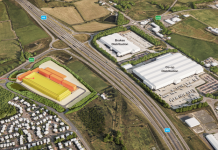







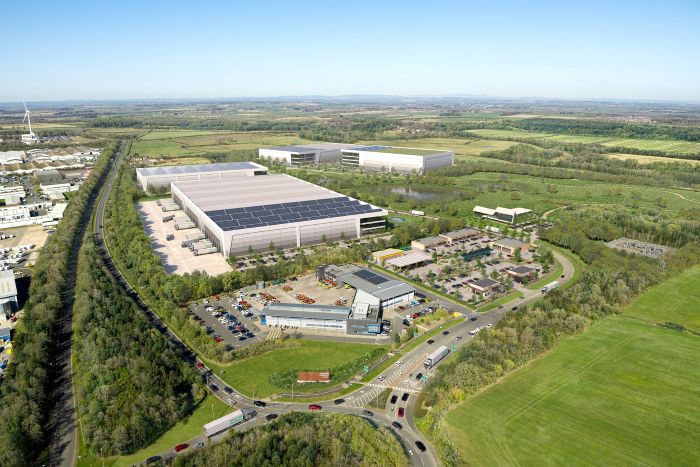
Arlington Real Estate and Homes England have submitted a masterplan outline planning application for West Hartford Park, a landmark development on the edge of Cramlington, North East England, that aims to deliver more than one million sq ft of high-quality, market-leading industrial, manufacturing and logistics space for Northumberland.
Located just minutes from the deep-sea Port of Blyth, West Hartford Park is the largest remaining strategic employment site in Northumberland, spanning 126 acres.
The proposed development seeks to support the expansion of the port and forms a key part of the Energy Central Partnership, which positions South East Northumberland as a national hub for offshore and renewable energy, clean technology and advanced manufacturing, while also supporting the recently announced AI Growth Zones.
The Port of Blyth, home to the ORE Catapult’s world-leading testing facilities, is working closely with Arlington and Homes England to maximise economic impact and attract major national and international investors.
As a result, West Hartford Park has already generated strong interest from a number of large-scale occupiers, even before the scheme has officially launched its marketing campaign, which is scheduled for early 2026.
The scheme is expected to deliver approximately 2,000 new jobs and generate more than £400 million of investment for the North East economy.
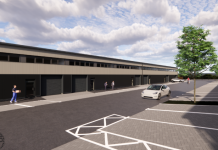
The masterplan sets out the delivery of flexible B2/B8 units ranging from 174,375 sq ft to 532,000 sq ft, available on both freehold and leasehold terms, as well as office space, ancillary retail and cutting-edge education and innovation facilities. Each unit can be tailored to occupier requirements and will benefit from significant power capacity, high-quality infrastructure and exceptional connectivity.
The development sits adjacent to an established cluster of industrial, logistics and innovation businesses, enabling occupiers to tap into a highly skilled local workforce, mature supply chains and major transport corridors, alongside global connections via the Port of Blyth.
Designed with sustainability at its heart, West Hartford Park will set a new regional benchmark for environment-led employment development. More than 35% of the site is dedicated to green and open space, creating a unique business park environment with enhanced biodiversity, nature trails, walking routes and on-site amenities, including a coffee shop and other ancillary uses.
The landscaped setting provides an attractive environment for occupiers, staff and visitors, balancing high-quality workspace with wellbeing-led design.
Dean Cook, Managing Director of Arlington Real Estate, said: “Submitting the planning application marks an important milestone in unlocking the full potential of West Hartford Park. This is the only site in the region capable of delivering development at this scale, in a location that has the power, infrastructure and global connectivity that large occupiers require.
“Collaboration with the Port of Blyth means this project will directly support the growth of the offshore and renewable energy sector, as well as advanced manufacturing, logistics and AI sectors, bringing jobs, investment and long-term economic value to Northumberland and the wider North East.
“There is already strong interest from major national and international businesses, and we believe West Hartford Park will become a significant commercial location not only for the region, but for the UK.”
Councillor Richard Wearmouth, Deputy Leader of Northumberland County Council and Cabinet Member for Business, Growth and Regeneration, said: “This is very welcome news for our largest remaining employment site in the current local plan.
“Making maximum use of the West Hartford site is incredibly important to our ongoing drive to bring further investment and job opportunities into Northumberland.”
Martin Lawlor OBE, Chief Executive of the Port of Blyth, said: “We are delighted to be working in partnership to help develop West Hartford Park. Once approved, the site will not only provide important additional capacity for port-related development but will also be a catalyst for further economic growth across the region.”