

















A series of internationally significant discoveries are helping reveal new insights into Swansea’s world‑famous industrial story.
Archaeologists working on the former Hafod‑Morfa Copperworks site – soon to undergo major transformation thanks to Swansea Council regeneration plans – have uncovered rare evidence of historic copper‑processing techniques.
It includes machinery, masonry and furnace networks dating back centuries.
The finds provide an unprecedented window into the evolution of copper manufacture in the Lower Swansea Valley, which once produced an extraordinary proportion of the world’s supply.
Council leader Rob Stewart said: “It’s fantastic that our finds at this historic site will be enjoyed and studied for decades to come.
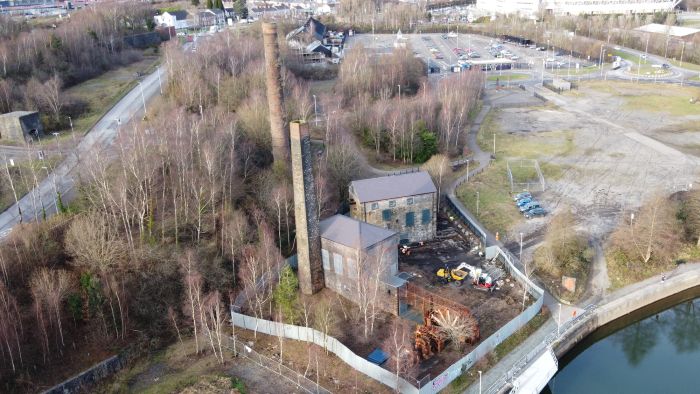
“I thank the expert archaeologists for their ongoing work to catalogue the exciting discoveries in the area of the Musgrave and Vivian engine houses.
“Work on this location’s main transformation will start soon – the engine houses will be made available for a range of exciting public uses.”
Libby Langlands, assistant project manager at Black Mountains Archaeology, said: “We undertook an 18-month full‑scale archaeological excavation to discover and record complex industrial remains buried on the site of the engine houses and attached rolling mills.
“Our work will help inform future building designs and heritage interpretation there.”
The Vivian Engine House was built in 1860, the Musgrave Engine House around 50 years later.
Among the most important discoveries there are:
- A buried machine pit beneath the Musgrave copper rolls, containing surviving machinery including original balancing gears. These remains provide rare, physical evidence of how large-scale copper rolling machinery operated on the site.
- Evidence for a previously unknown line of copper rolling machinery, likely associated with the earliest phase of the Vivian Engine House. This discovery has been supported by historic plans held in the Musgrave archives, revealing earlier stages of development not previously recognised.
- Substantial masonry walls and structural remains predating the existing engine houses, representing earlier 19th century beam engine and rolling mill buildings on the site. Together with historic maps and drawings, these remains are helping archaeologists reconstruct how the works evolved over time.
- A network of brick-built furnaces and flues used to heat, or “anneal”, copper before rolling, a vital process that softened the metal and prevented it from cracking. These features illustrate the advanced industrial techniques developed in Swansea during its peak period of copper production
These, the archaeologists say, are of international significance. They add fresh detail to Swansea’s industrial timeline while highlighting the importance of preserving and interpreting the site for future generations.
The Musgrave Engine — the only example of its kind in the world still in its original location — is a nationally significant scheduled monument. Alongside the Grade II‑listed pair of engine houses, it forms a key part of the heritage now being better understood through this detailed archaeological work.
Thousands of photographs have been captured as part of a high-tech 3D imaging programme, allowing archaeologists to create highly accurate digital models of the site’s features. This will help historians interpret the finds long after physical work on the site has finished.
All archaeological reports, surveys, plans, drawings and photographs will be archived in the National Monuments Record, curated by the Royal Commission on the Ancient and Historical Monuments of Wales and the Historic Environment Record curated on behalf of the Welsh unitary authorities for anyone to access.
Heritage organisations Cadw and Heneb continue to work closely with the council and partners to ensure that significant features are preserved, and — where necessary — sensitively re‑covered in situ to protect them for future generations.
Dr Kate Roberts, chief executive of Cadw, said: “These extraordinary discoveries at Hafod Morfa remind us why Swansea’s copper industry holds such an important place in world history. Cadw has been proud to work alongside Swansea Council and our partners over several years to breathe new life into this remarkable site, taking buildings like the Powerhouse, Weigh Bridge and Rolling Mill off the Buildings at Risk Register and securing their future. The archaeological work now being revealed at the Musgrave and Vivian Engine Sheds demonstrates what can be achieved through genuine collaboration. By working together, we are ensuring that these historically significant remains are properly recorded and protected, while creating spaces that future generations can enjoy and learn from.”
Judith Doyle, regional lead for Heneb GGA Region said: “Copperopolis is world renowned and Heneb, as the archaeological advisors to Swansea Council, are extremely pleased that the importance of the works itself and the exciting history of copper working in Swansea and Lower Swansea Valley is being recognised, recorded and will be interpreted for posterity.
“The successful achievement of the project is a tribute to the diligent collaborative working between all the partners involved over the last few years.”